
 Orji Chigozie Henry
Studying for hours without remembering much can leave you tired, frustrated, and unsure where your time went. The problem usually isn’t a lack of effort; effective studying depends more on having a clear plan and using methods that help your brain work with the material.
With the right approach, you can plan your study time, stay focused, and remember more through active learning, practice questions, and spaced review. Short breaks, enough sleep, regular movement, and realistic goals also support better concentration and help you avoid burnout. Learning how to manage time can make it easier to balance schoolwork with rest and other responsibilities.
The practical study tips ahead will help you organize each session, prepare for tests, retain important information, and build habits that make studying feel more manageable. Start by creating a study plan that fits your schedule and gives each subject the attention it needs.
Key Takeaways
- Create a realistic study plan that divides subjects into focused sessions and leaves room for rest.
- Use active recall by answering questions, explaining concepts aloud, or writing summaries without checking your notes.
- Review material across several days instead of cramming the night before. Distributed practice supports stronger long-term retention.
- Mix practice questions, flashcards, and past exams to identify gaps and strengthen memory.
- Protect your concentration with short breaks, adequate sleep, regular movement, and a consistent daily routine.
Study Tips for Students That Make Learning Easier
Studying becomes easier when you work with a clear purpose. Instead of rereading notes and hoping the information stays with you, decide what you should be able to explain, solve, or remember by the end of each session. A focused goal gives your attention somewhere to go.
Break large assignments into small tasks you can finish in one sitting. For example, change “study biology” into “review cell notes, make five questions, and complete a practice quiz.” You can also use effective time management strategies to give each task a realistic place in your schedule.
Use Active Recall Instead of Rereading
Active recall means trying to retrieve information before looking at your notes. Close the book and write everything you remember about a topic. Then check your notes, mark the gaps, and test yourself again.
You can also turn headings into questions, use flashcards, or explain a concept aloud. The active recall study method works best when you answer first and check the correct response afterward.
Teaching the material in simple words is another useful test. Pretend you’re explaining photosynthesis to a younger student. If your explanation becomes vague or overly complicated, return to the material and find the missing connection.

Space Out Reviews and Practice Questions
Spaced repetition helps you review information across several days instead of cramming it into one exhausting session. Try reviewing new material on the same day, the next day, three days later, and again the following week. During each review, recall the answer before checking it.
Practice questions show whether you can use information, not just recognize it. After each set, review every mistake. Ask why your answer was wrong, write the correct process in your own words, and try a similar question later.
Different subjects need different tools:
- Math usually requires worked examples and repeated practice problems.
- Vocabulary often improves with flashcards and short self-quizzes.
- Science benefits from diagrams, practice questions, and teach-back explanations.
- History may require timelines, comparison questions, and cause-and-effect summaries.
Keep each study session narrow enough to measure. A clear task gives you feedback, and that feedback tells you what to study next.
How to Build a Study Routine You Can Keep
A study routine works best when it fits your actual life. Start with a weekly plan, then turn that plan into manageable daily blocks. Leave enough room for sleep, meals, exercise, work, and unexpected changes. A schedule that ignores your basic needs will become difficult to follow.
Create a Realistic Weekly Study Plan
Begin by writing down your fixed commitments. Include classes, work shifts, meals, exercise, appointments, and your usual sleep schedule. These commitments create the frame for your week, so add study time only after you see where your available hours are.
Next, list upcoming exams, assignments, and reading deadlines. Separate urgent tasks, which need attention soon, from important tasks, which support long-term progress. A paper due tomorrow is urgent, while reviewing algebra each week is important. Both belong on your schedule, but urgent work may need the earlier block.
Use time blocking to assign each task a specific period. For example, you might reserve Tuesday from 4:00 to 4:50 p.m. for biology practice questions, then schedule a shorter review session on Thursday. Plan extra time for difficult assignments because unfamiliar topics often take longer than expected. Harvard’s student time-management guidance also recommends creating a calendar, prioritizing tasks, and building a schedule that fits your needs.
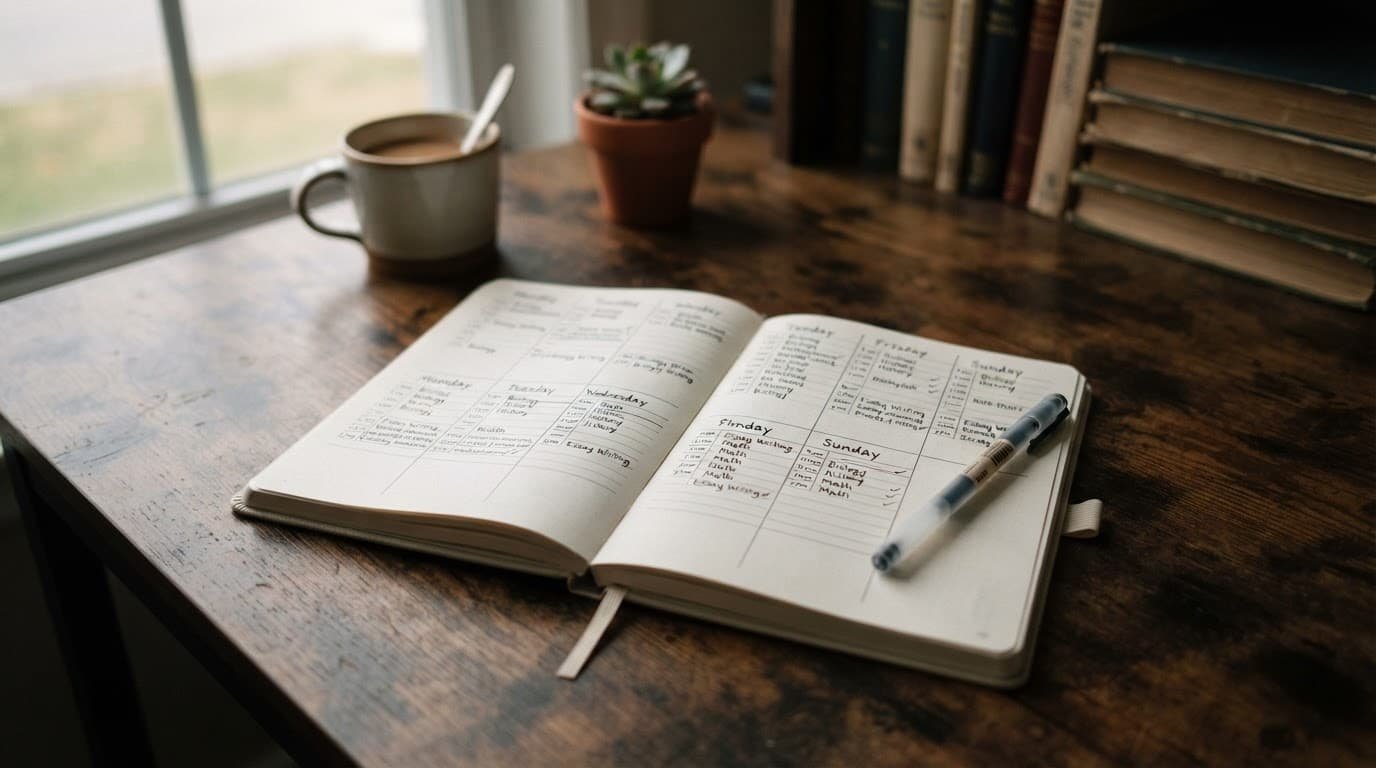
A regular start time can make studying easier to begin. Choose one dependable anchor, such as 6:00 p.m. after dinner or 9:00 a.m. before your first class. You can find more ideas for how to structure your day when you build this anchor into a broader routine.
Turn the Plan Into Daily Study Blocks
Each morning, check your schedule and choose the most important task for the day. Adjust the order if a deadline changes, but keep the overall workload realistic. Your daily plan should tell you what to study, when to start, and what finished work looks like.
For focused work, try the Pomodoro method:
- Study for 25 minutes without switching tasks.
- Take a five-minute break to stretch, drink water, or rest your eyes.
- Repeat the cycle four times.
- Take a longer break before starting another set.
Some students focus better for 45 to 60 minutes, followed by 10 to 15 minutes of rest. Test both options and keep the pattern that helps you maintain attention without feeling drained.
A useful routine is adjustable. Missing one block should lead to a revised plan, not an abandoned one.
Review your schedule each evening or morning, then move unfinished work to a specific later block. Life will interrupt your plans sometimes, so flexibility matters more than perfection. A routine you can adjust is far more useful than an impressive schedule you cannot maintain.
How to Focus When Your Phone and Other Distractions Get in the Way
A good study plan can still fail when your phone, background noise, or open browser tabs keep pulling your attention away. Focus improves when you shape your environment before you begin, rather than relying on willpower during every study session.
Remove Digital Distractions Before You Start
Put your phone out of sight and out of reach, such as in another room, inside a backpack, or across the room. Turn off notifications on your phone and computer, then use airplane mode or Do Not Disturb during the focus block. If you need your phone for study materials, block social media and entertainment apps with a tool such as AppBlock or StayFocused.
Even a phone that you aren’t using can compete for attention. A review of digital distractions in education identified technology-related distractions as a major source of lost focus, so reducing access can make studying easier. You can also find more practical ideas for how to eliminate distractions when interruptions keep affecting your routine.
Multitasking makes the problem worse. Switching between a textbook, messages, videos, and assignments forces your brain to repeatedly reload each task. That takes time and increases the chance of skipped instructions, calculation errors, and incomplete work. Choose one task for each focus block, then keep only the materials you need nearby.
Use a timer to stay aware of your progress without checking the clock. Try 25 minutes of study followed by a five-minute break, or work for 45 minutes and rest for 10. During breaks, stand up or drink water instead of opening an app that may pull you into another activity.

Adapt Your Study Space to the Situation
A quiet library may help when your home is noisy. If you share a room, use headphones with soft instrumental music or steady background sounds, and tell others when your study block will end. At home, choose one regular spot and clear away unrelated items before opening your book.
Online classes need extra boundaries. Close unrelated tabs, silence group chats, and keep your class window at full size. Write down distracting thoughts on a sheet of paper so you can return to them later without abandoning your work.
Procrastination often feels harder than the task itself. Start with a five-minute action: open the book, write the first question, or set up the document. Once you begin, continuing usually feels more manageable. If your attention still wanders, adjust the space or shorten the next block instead of blaming yourself.
Study Habits That Support Memory, Energy, and Confidence
Strong study habits support more than grades. They help you remember information, protect your energy, and build confidence through steady progress. Your brain works best when studying fits alongside sleep, meals, movement, relationships, and time to recover.
Protect Your Energy While You Study
Sleep gives your brain time to process and store what you learned. Studying while exhausted may feel productive, but tired attention often leads to slower reading and weaker recall. When possible, stop earlier and return after a full night’s rest.
Regular meals and water also support concentration. Keep a simple snack and a water bottle nearby, especially during longer study blocks. After 25 to 60 minutes of focused work, take a short break to stand, stretch, walk, or rest your eyes. Research on active breaks links brief physical activity with cognitive and emotional benefits, as described in this research on active study breaks.

Hobbies, friends, exercise, and quiet time belong in a healthy study plan. They aren’t signs of laziness. These activities give your mind a chance to recover, so you can return with better focus. Building daily discipline can help you protect both study time and personal time.
Build Confidence Through Small Wins
Confidence grows when you collect evidence that you can follow through. At the end of each session, record what you completed, such as reviewing two sections or finishing ten practice questions. A visible record turns vague effort into measurable progress.
Reward completed work with something simple, such as a favorite snack, music, or time with a friend. When you make mistakes, review them without calling yourself careless or incapable. Ask what caused the error, correct the process, and try a similar question later. Errors are information about your next step.
If you keep falling behind, ask for help early. A teacher can clarify expectations, a tutor can explain difficult material, a classmate can study with you, and an advisor can help adjust your workload. Asking for support is a study skill, not a personal failure.
Manage Test Anxiety With a Clear Plan
Preparation reduces uncertainty, but anxiety may still appear during an exam. Before starting, breathe in slowly and exhale for a little longer. Remind yourself, “I can handle one question at a time.”
Read the directions, scan the test, and begin with a question you understand. That first answer creates momentum. If your mind freezes, place both feet on the floor, take one slow breath, and write down the relevant formula, definition, or first step. Then continue from there.
Frequently Asked Questions
Small changes can make studying more effective, but the best approach depends on your schedule, energy, subjects, and deadlines. Use these answers to adjust your routine without turning schoolwork into a test of endurance.

How many hours should a student study each day?
There is no single number that works for every student. Your course load, upcoming deadlines, current understanding, and available time all affect how much study you need.
Focus on productive blocks instead of counting hours alone. Try 25 to 50 minutes of concentrated work, then take a short break before continuing. Two focused blocks may help more than several distracted hours, especially when you set a clear goal for each session.
What is the best study method for remembering information?
Active recall and spaced repetition are strong starting points. Close your notes and quiz yourself, explain the topic aloud, or write down what you remember before checking the correct answer.
Then review the material over several days, with longer gaps as you become more confident. Passive rereading can feel familiar without proving that you can recall the information. Research on active recall and spaced repetition examines why combining these methods can support long-term retention.
Is it better to study in the morning or at night?
The best time is when you have enough energy and the fewest distractions. Some students think clearly in the morning, while others focus better after classes or in the evening.
Choose a study period you can use consistently, then protect your sleep. A late-night session that leaves you exhausted may hurt your concentration the next day, even if you complete more pages.
How can I stop procrastinating on a large assignment?
Break the assignment into the smallest visible actions. Open the document, write the title, find one source, or create three headings instead of putting “finish paper” on your task list.
Pick one starting task and set a timer for five minutes. Beginning briefly can make the assignment feel less overwhelming, and you can decide whether to continue when the timer ends.
Should I listen to music while studying?
Music helps some students, especially during routine work such as organizing notes or completing familiar exercises. However, lyrics, loud sounds, and frequent song changes may interrupt reading and problem-solving.
Test quiet background music, instrumental tracks, or silence during difficult tasks. Keep the option that helps you stay focused without repeatedly checking or changing the audio.
What should I do if my study plan stops working?
Review what caused the problem before rewriting the entire plan. Maybe you underestimated an assignment, scheduled too many blocks, ignored travel time, or needed more rest.
Reduce the schedule to its essential tasks, then rebuild it with more realistic time estimates. Adjusting your plan is a useful response to new information, so one difficult week doesn’t mean you should give up or criticize yourself.
Conclusion
Studying for hours does not guarantee that you will remember more. Effective study is built from small, repeatable choices: set clear priorities, practice active recall, work in focused blocks, take useful breaks, and get enough rest. These habits make your time more productive without requiring an exhausting schedule.
You don’t need to change your entire routine this week. Choose two tips, such as testing yourself after each section and studying at a consistent time, then practice them for several days. If procrastination keeps interrupting your plan, these practical ways to stop procrastinating can help you begin with less resistance.
Progress comes from consistency, not perfection. Each focused session gives you another chance to learn, adjust your approach, and build confidence in your ability to improve.
Save the pin for later


- 8 Signs Your Ex Is Testing You And What It Really Means - September 18, 2026
- 12 Qualities Every Good Man Should Have - September 18, 2026
- How to Write a Dating Profile for a Woman Over 45: 9 Simple Steps - September 18, 2026